Key Takeaways
- Money milestones for your 30s center on building a positive net worth and strong credit by moving out of survival mode, reducing debt, and ensuring your net worth and credit score are trending upward year over year.
- Eliminating bad debt like credit cards and buy-now-pay-later balances is critical, while responsibly managing good debt helps free up cash for saving, investing, and future goals.
- A true emergency fund of three to six months of expenses is essential to avoid financial derailment from unexpected events and reduce reliance on high-risk borrowing.
- Retirement investing should accelerate in your 30s by consistently contributing to tax-advantaged accounts, taking advantage of employer matches when available, and using compound growth to build long-term wealth.
We’re not going to sugarcoat it. If you don’t have a strong financial foundation in your 30s, you’re in for a lifetime of difficulty. But don’t worry! Even if you feel behind right now, there’s plenty of time to catch up.
Let’s break down the realistic money milestones to hit in your 30s and where the average 30-year-old actually stands right now.
Money Milestone #1: Build Positive Net Worth and a Strong Credit Score
The first milestone is building a positive net worth and building a strong credit score. The average credit score for a person in their 20s is 662.8 That’s because in your 20s, you’re starting to build your credit, and it may take some time to gain traction.
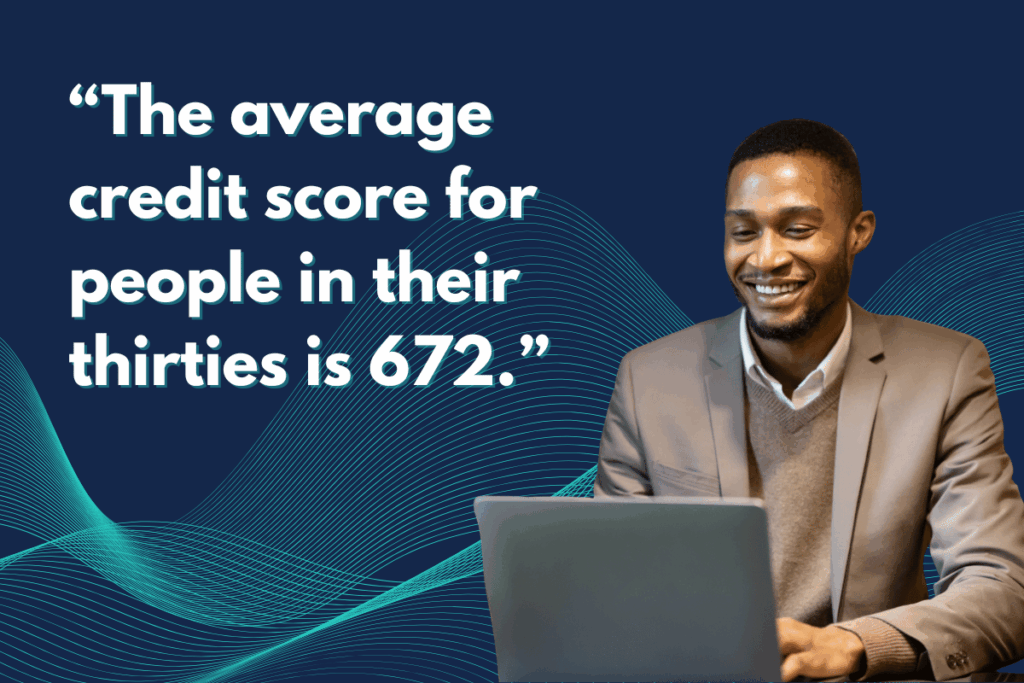
Now that you’re in your 30s, you may have a 10-year credit history, more lines of credit, and more types of credit, like a car loan, or if you’re lucky, a mortgage, but it’s still surprising that the average credit score for people in their 30s is 672.8
Ideally, you’re making your way to the 700s in your 30s. So, when you need to buy a house, you can get a better interest rate.
People in their 30s have an average net worth of about $300,000, while the median is just $35,000.10 The median gives us a better picture of the typical American because those really high earners skew the average up. So don’t worry if you’re not in the six figure range, but the gap between the median and average net worth does show us two things:
- First, a handful of people are doing really well and pushing the average up.
- Second, tons of people are still far below average. How many of your friends have a multiple six-figure net worth right now?
The important thing here is that you’re moving past the just surviving phase of your life and starting to build your net worth, whether it’s through a home, a retirement account, or paying off debt.
When you’re in your early 30s, your net worth might still be low or even negative thanks to student loans, car loans, and credit cards. But by mid-30s, you should be seeing that number move in the positive direction. So, if you’re at 30 and your net worth is flat or shrinking, it’s a red flag that tells you something needs to change, it’s a sign that debt, spending, or lack of income growth is dragging you down.
Look back at your net worth and credit score from last year. Did it go up? Great! If not, find the cause and set a goal to fix it. Whether it’s increasing your contributions to your retirement accounts, increasing your income, or paying off debt to get that credit score up.
Money Milestone #2: Get Rid of Bad Debt
The second financial milestone is to get rid of your bad debt. And that is the key word here, bad debt. Bad debt is something like credit card debt or buy now pay later debt that drags down your credit score instead of building it. On the other hand, we have good debt, such as home loans or student loans. These are considered good because they can actually help you build your credit score if you pay on time and help you save and make money in the long run.
People between 30 and 39 carry an average student loan debt balance of about $42,000, about $6,900 of credit card debt, and roughly $84,000 of mortgages and other debt.4
Now, in your 20s, debt is usually chaotic because you have every form of debt that eats away at your paycheck the second it hits your bank account. It’s like a pack of sharks, right? The money comes in and then it’s going to student loans, car loans, credit cards, and rent before you even blink. And you have almost no money as you’re just starting out in your career.
But in your 30s, you essentially want all of your bad debt off the books so that you could put it towards things like savings, retirement, or the house that you want to own.
This means paying your credit card balance in full each month, and paying all of your loans and balances on time. Every late payment decreases your credit score.
We have made several videos on improving your credit score:
- If I Had to Fix My Credit Score Fast, This Is How I’d Do it
- Do THIS When You Can’t Get Approved for a Loan
- Is This Credit Repair Strategy Illegal
- How I Raised My Credit Score 100 Points in 1 Day
The goal isn’t to be debt free in your 30s because for most of us that isn’t realistic. If you can pay off your home in your 30s, congrats, because that would put you in the top 10% of 30-year-olds who do pay off their home.
But holding good debt isn’t necessarily a bad thing. You just need to pay on time and prove you’re a trusted borrower. Now, if you’re still mostly paying minimums on credit cards or you’re spending more than you bring in, then you’re going in the wrong direction.
If you’re curious about how to pay off debt even when you’re tight on cash, check out this video:
Carrying bad debt is essentially going to hold you back financially for as long as you have it. So, the sooner it’s gone, the better.
Money Milestone #3: Build an Emergency Fund
And for the third financial milestone, you should have an actual emergency fund.
Look, we know there isn’t anything exciting about grinding away at work to watch the numbers on your banking app go up, but the art of saving money is lost, and it’s creating a major problem. The median savings for those under 35 is $5,400 and the average saving balance is $20,000. And for those between 35 and 45, the median is $7,500 and the average savings is $41,000.11
But if we want a real emergency fund, it’s recommended by finance pros to have 3 to 6 months of monthly expenses. And based on the median numbers, we aren’t hitting our targets. Like we just saw, our median ranges from $5,400 to $7,500, which means monthly expenses would have to be $1,800 to $2,500 if our goal is to have at least a three-month cushion. If you don’t yet have that fund, you’re vulnerable and a single unexpected event could derail your financial momentum.
By the way, if an emergency does happen and you don’t have your emergency fund yet, please do not ever resort to a payday loan. They’re predatory loans that trap people in debt.
A way safer option is getting a personal emergency loan through a five-star rated lender like CreditNinja that could send you funds as fast as the same day. You can learn more in this video:
Like with homes, lots of people in their 20s and 30s would save for a home because it felt affordable. Now that homes have gone up in price, some people might think they won’t ever be able to afford a home. So they don’t see the point in saving for one. So now people are spending and wasting money on things that they don’t need, like ordering from DoorDash every night instead of cooking and saving for a strong financial future. There are people out there financing burritos on Door Dash now. It’s too much. You got to get real with yourself. If you don’t have an emergency fund yet, focus on cutting unnecessary spending. And make this a top priority after paying down bad debt. Because if you don’t, you’re one emergency away from drowning in debt for the rest of your life.

Money Milestone #4: Build Your Retirement and Investment Accounts
The fourth financial milestone is building your retirement and investment accounts. Americans in their 30s have average retirement balances of about 249,000 with a median of about 91,000.2 If you watched our financial milestones in your 20s video, you’ll know that you should start adding to your retirement account in your 20s. But the 30s are where things should really kick into gear.
Now, if you haven’t started saving for retirement yet, we’re not going to lie, the best time to start saving was 10 years ago. But the next best time is now. You really can’t afford to wait.
If your employer sponsors a 401k, put money in every month. See if you have the option to set it up to where it auto-drafts from your paycheck, so you don’t even need to think about it. Many employers do a 401k match where they match a certain percentage of what you invest. That’s free money!
I don’t want to get too into the weeds of taxes here, but anyone can open up a Roth IRA where you can contribute up to 7500 a year and it grows tax-free. Now, if your employer doesn’t sponsor a 401k, you can still open up your own IRA instead. The reason this is so important is that inside these retirement accounts, you can make your money make more money. By investing in stock market ETFs that grow month by month, year-by-year, your $10,000 today can become $100,000 in 30 years if the ETFs grow at an average of 8% a year. This is thanks to compound interest.
With the big stock funds like ones that track the S&P 500, the general growth is 8% a year. Now, some years the market can go down a bunch or it can go up 20%. So when we look at this compound growth curve, the earlier you start, the faster things take off. So if you’re behind now, you can catch up by being more aggressive and putting your extra cash towards retirement.
After you’ve built your emergency fund, if you have leftover cash every month, maybe you want to contribute more. But no matter what, if you want to maximize the money you have for retirement, it’s crucial to start ASAP.
Money Milestone #5: Real Estate and Housing Planning
And for the fifth milestone, we have the one that almost everyone dreads, and that’s making a decision on what you want to do with buying a home. For a lot of us, your 30s often come with major life transitions. Buying a home, maybe kids. These are exciting things, but without preparation, major life transitions can quickly kill your savings and debt reduction goals. Here are some data points that you need to know:
- The median home price in the US recently hovers around $415,000, though this varies heavily by region.12
- The median age of a first-time home buyer is currently 40 years old. This is wild when you consider that in 2020, the median was 33 years old.12
This is in large part because of what happened during COVID. Interest rates went low. Everyone tried to get a home which pushed the prices up and then interest rates rose and some prices stayed the same. (You can watch our video on buying a home here).
If we look at a real example, we can take the median home and current interest rate and plug it into our calculator. Assuming we confront the $80,000 down payment, our mortgage would be around $2,400 a month. If you’re living with somebody, this could be doable. But if you’re single, you have to be making some serious money to afford it. Experts say your mortgage shouldn’t be more than one-third of your salary, so you’d need to be making six figures solo or together with your partner. When you’re buying a home, the more you can put down in your down payment, the less you have to pay each month, and the less interest you’ll have to pay over the long term for a home.
Some tips to help make buying a home more affordable include:
- Contribute money to a high yield savings account each month for a future down payment so that the money can grow with interest.
- Put money into 6 month or 12 month CDs, which may give you a bit more interest. This ensures that you don’t spend this money and that it’s earning more interest while you’re waiting to buy a house.
We know things seem to get really serious in your 30s, and it’s true. We’re like fully adulting adults now. Saving, not wasting money, paying the rest of our student loans, always paying our balance on credit cards on time, and only upgrading when we have to and when we can afford it. If you want to own a home, you have to be intentional with your plan.
If you’re smart and want to stay on top of your finances, check out the CreditNinja blog!
Sources:
- The average 401(k) balance by age | Empower
- Average retirement savings by age | Empower
- The Average American’s Monthly Expenses | Ramseysolutions.com
- Average American debt by age and generation in 2023 | creditkarma
- The Demographics of Household Debt In America | Debt.org
- What Is the Average Credit Card Debt for a 30-Year Old? | SoFi Learn
- Debt Statistics | WalletHub
- Student Loan Debt by Age | Educationdata.org
- Average credit score by age in the U.S. | Chase
- The average net worth by age in America | Empower
- What Is the Average Savings Account Balance? | Smart Asset
- The Median Home in the US Costs $415,000. Here’s What that Will Buy Around the Country. | Metro Atlanta CEO