The average payday loan interest rate in 2026 remains around 391% APR, though the exact rate can vary by state, lender, loan amount, and repayment term. Payday loans are small, short-term cash advances that are typically due on your next payday. While they may provide quick access to money, the rates associated with these loans can translate into extremely high annual percentage rates when calculated over a full year.
Many people turn to payday loans when they’re facing an unexpected expense and don’t have enough savings to cover it. Maybe your car breaks down days before payday, a medical bill catches you off guard, or you’re short on cash to pay an essential utility bill. In situations like these, a payday loan can seem like a fast solution, but it’s important to understand the costs before borrowing.
The Consumer Financial Protection Bureau (CFPB) continues to oversee payday lending practices and has implemented protections aimed at reducing some of the most harmful collection tactics. Even with these safeguards, payday loans remain one of the most expensive forms of borrowing. Consumer advocates regularly warn that repeated borrowing, rollovers, and accumulating fees can make it difficult for some borrowers to get out of debt, making it important to compare alternatives before taking out a loan.
Key Takeaways
- The average payday loan interest rate in 2026 is 391%.
- A typical two-week payday loan charging $15 per $100 has an annual percentage rate (APR) of approximately 391%.
- In states without APR caps, payday loan rates can top 600%, while 36% cap states cut costs or eliminate payday lending.
- Credit union Payday Alternative Loans (PALs) cap APRs at 28%, making them a lower-cost option for eligible borrowers.
What Are Payday Loan Interest Rates?
A payday loan is typically $500 or less and is designed to be repaid in full within a few weeks. To get this type of loan, payday lenders almost always require borrowers to have a bank account, since repayment is often made through an electronic withdrawal on the due date.
Loan amounts from payday lenders and interest rates vary widely by state. Some states set strict caps, such as 36% APR, while others permit much higher rates that can exceed 300% to 600% APR. In addition to interest, payday loans carry finance charges that usually range from $10 to $30 per $100 borrowed, which can make the total cost far higher than many borrowers expect.
How Do Payday Loan Interest Rates Work in 2026?
In 2026, payday lenders’ interest rates work by converting a short-term, flat fee into an annual percentage rate (APR) so the true cost can be compared to other loans. In practice, lenders charge a flat finance fee for a two- to four-week loan, and that one-time fee, when annualized, becomes the very high APR numbers people see.
How Payday Loan Interest Works
If you’re interested in acquiring this type of loan, it is important to understand how a payday loan rate is calculated. Before borrowing money, you should always be aware of the potential drawbacks to avoid predatory lending practices.
Below is an example of a payday lending calculation:
- The Lender Charges a Flat Fee – Example: $15 fee for each $100 borrowed on a typical two-week (14-day) payday loan.
- Compute the Fee as a Fraction of the Principal – Fee / Loan amount = 15 ÷ 100 = 0.15 (this is the portion of the loan charged for the term).
- Annualize the Short-Term Fee to Get the APR – Formula (simple annualization):
- APR (%) = (Fee ÷ Loan Amount) × (365 ÷ Loan Term in days) × 100 –
Using the example:
- 365 ÷ 14 = 26.0714285714
- 0.15 × 26.0714285714 = 3.91071428571
- 3.91071428571 × 100 = 391.071428571% → ≈ 391.07% APR
What Are The Current Average APRs For a Payday Loan In The U.S?
There isn’t one single “average” APR you can point to; payday loan APRs typically fall in a very high range (roughly 300%–600% APR), depending on the fee structure and state rules.
A common pricing example helps explain why: a $15 fee per $100 on a typical two-week payday loan annualizes to about 391% APR. This is widely used to illustrate how small short-term fees turn into high-cost payday lending annual rates.
Rates differ dramatically by state and by loan structure. In some states, payday loans are effectively capped or banned entirely, while other states allow single-payment loans with reported average APRs well over 500%. For example, Pew found an average APR of 652% for a single-payment $500 payday loan in Idaho.
What Are the Payday Loan Interest Rates By State in 2026?
| State / DC | Classification | Note |
| Alabama | Less strict | Allows very high short-term APRs; no effective 36% cap. |
| Alaska | Strict | State APR cap for small loans at or below 36%. |
| Arizona | Strict | Enforces a 36% APR cap on consumer loans. |
| Arkansas | Strict | Low APR caps that effectively block storefront payday lending. |
| California | Less strict | Payday-style products are available with relatively high APR ceilings. |
| Colorado | Strict | Loans of $500 or less are capped at 36%. |
| Connecticut | Strict | Strong restrictions that make traditional payday loans largely unavailable. |
| Delaware | Less strict | No statutory 36% cap (higher allowable rates or special rules). |
| Florida | Less strict | Allows high short-term APRs under state law. |
| Georgia | Strict | Payday-style lending is tightly restricted for small amounts, but higher-cost products exist. |
| Hawaii | Strict | Caps limit payday-style lending (≈36% or lower effective cap). |
| Idaho | Less strict | Very high allowable rates / weak cap (effectively permissive). |
| Illinois | Strict | Recent reforms tightened rules with 36% APR cap on consumer loans. |
| Indiana | Less strict | Permits high short-term APRs; not in the ≤36% group. |
| Iowa | Strict | Statutory cap at or near 36% for small closed-end loans. |
| Kansas | Less strict | Allows high short-term APRs. |
| Kentucky | Less strict | Permits high APRs for short-term loans. |
| Louisiana | Less strict | High allowable APRs for short-term payday-style loans. |
| Maine | Strict | Interest limits that fall at or below the 36% benchmark for small loans. |
| Maryland | Strict | State caps that effectively prohibit high-cost payday storefront loans. |
| Massachusetts | Strict | Strong restrictions on payday-style loans with 23% APR cap. |
| Michigan | Less strict | Higher allowable APRs for short-term products. |
| Minnesota | Less strict | Recent reforms (2024) tightened rules — but still not classified here as a universal ≤36% cap for all product sizes. |
| Mississippi | Less strict | Allows very high APRs under certain laws. |
| Missouri | Less strict | No effective cap; permissive. |
| Montana | Strict | Caps that put it at or below the 36% threshold for small loans. |
| Nebraska | Strict | Caps the maximum of 36% on payday loans. |
| Nevada | Less strict | Allows relatively high APRs for short-term loans. |
| New Hampshire | Strict | 36% (or similar) cap applies to many small closed-end loans. |
| New Jersey | Strict | Strong rate limits (≤36% in many cases). |
| New Mexico | Less strict | Historically high caps reduced by reform in recent years, still not universally ≤36% for all small loans. |
| New York | Strict | Criminal usury limits and caps make high-cost payday storefront lending effectively unavailable. |
| North Carolina | Strict | Low statutory caps for many small loans (well under 36% for relevant products). |
| North Dakota | Strict | 36% (or lower) statutory cap for non-bank consumer loans. |
| Ohio | Less strict | Multiple laws with varying caps; allowed APRs above 36% for some short loans. |
| Oklahoma | Less strict | Permits very high APRs in some lending categories. |
| Oregon | Strict | Caps that put certain small loans at or below 36%. |
| Pennsylvania | Strict | Strong statutory limits that effectively bar traditional payday storefront loans. |
| Rhode Island | Strict | Small-loan caps at or below the 36% marker for many products. |
| South Carolina | Less strict | Permits high APRs for short-term loans. |
| South Dakota | Strict | State caps that meet the ≤36% benchmark for small loans. |
| Tennessee | Less strict | Very high allowed APRs for short-term lending. |
| Texas | Less strict | High permitted APRs for certain small loans (no universal 36% cap). |
| Utah | Less strict | Weak/wide statutory standards (unconscionability) rather than a tight 36% cap. |
| Vermont | Strict | Low APR limits (≤36% for the small-loan examples). |
| Virginia | Strict | Caps put many small loans at/under 36%. |
| Washington | Less strict | Allows relatively high APRs for some product types. |
| West Virginia | Strict | APRs for small loans are heavily capped at 31%. |
| Wisconsin | Less strict | No bright-line cap (unconscionability standard); classified as less strict here. |
| Wyoming | Strict | State caps that meet the ≤36% benchmark. |
| District of Columbia | Strict | Caps and rules that prevent high-cost storefront payday lending. |
Quick Facts About Payday Loan Fees:
- Some state averages and single-payment loans can exceed 500–600% APR.
- Typical fee range from payday lenders: $10–$30 per $100 borrowed (varies by state).
- Common shown APR for $15/$100 (14-day loan): ≈391% APR.
What Is My State’s Payday Loans Interest Rate?
State laws and regulations governing payday lending vary widely; some states cap short-term loan APRs, while others permit much higher average interest rates or allow storefront and online payday products to operate with few limits.
Some jurisdictions have moved to protect consumers: the District of Columbia and several states have adopted strict caps or outright bans on certain payday products, and a few states (and courts) have taken actions that effectively bar high-cost deferred-presentment loans.
Lenders must follow state rules on disclosure, licensing, and rate limits. Additionally, many states require clear fee disclosures and licensing for payday lenders to operate legally. The CFPB also enforces federal payday-lending rules that affect payment of consumer loans.
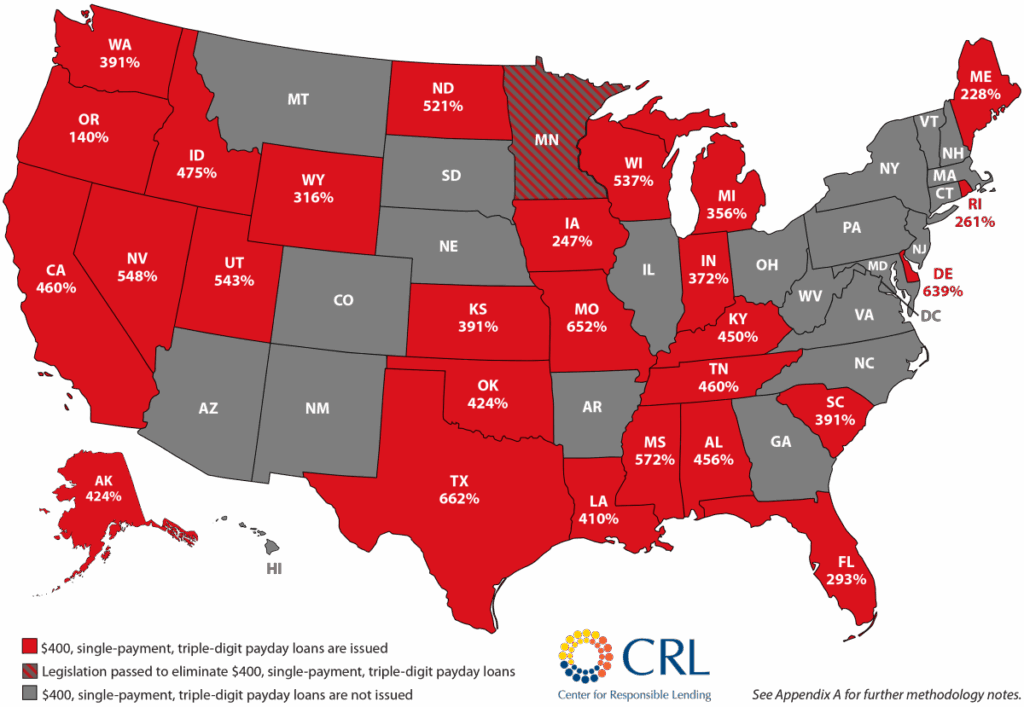
Quick Facts About State Regulations
- Wide variation across states: Some states allow APRs well above 600%, while others enforce caps as low as 36%, showing how borrowers’ cost experiences differ drastically depending on local regulations.
- Regulatory gaps persist: Over half of the U.S. still permits high-interest rates for payday loans, highlighting the need for stronger consumer protections.
- Effectiveness of rate caps: States enforcing caps (e.g., 36% APR) significantly reduce payday loan costs and help prevent debt traps—further underscoring the importance of legal safeguards.
What Are the Factors That Affect Payday Loan Interest Rates?
The main factors that affect payday loan interest rates are state laws and rate caps, lender type, loan amount, repayment term, and possible additional fees set by payday lenders. State regulations are the most influential in states with strict APR caps, where payday loans are much cheaper or unavailable. While in states without caps, APRs can exceed 600%. Lender type also matters: storefront, online, and fintech payday lenders each have different cost structures that influence pricing.
Loan size and term length play a role, too; smaller loans and shorter terms can produce higher effective APRs, while longer repayment periods spread out costs. Other influences include whether the loan is single-payment or installment-based, and extra costs such as rollovers, late fees, or insufficient funds charges.
Knowing these factors helps borrowers compare offers more accurately and anticipate the true cost, including financial obligations beyond just the advertised APR.
Factors At a Glance
- State Laws Drive Costs Most – APRs can be capped at 36% in strict states or exceed 600% where no caps exist.
- Loan Size, Term, and Type Matter – Smaller, short-term, or single-payment loans often lead to higher effective APRs.
- Extra Fees Add Up – Rollovers, late fees, and NSF charges can make payday loans far more expensive than the advertised APR.
What Are The Risks Involved With a Payday Loan?
The risks involved with payday loans include extremely high costs, short repayment windows, and a high likelihood of falling into a cycle of debt. Because these loans often come with triple-digit APRs and fees that compound quickly, many borrowers struggle to repay on time, leading to rollovers, additional fees, and mounting debt.
| Risk | Description |
| High APR | Rates often exceed 300%–600%, making loans very expensive. |
| Short Repayment Period | Typically due in 2–4 weeks, leaving little time to gather funds. |
| Debt Cycle | Rollovers and renewals can trap borrowers in long-term debt. |
| Bank Account Access | Lenders often withdraw payments automatically, risking overdraft fees. |
| Negative Credit Impact | Missed payments may be sent to collections, hurting credit scores. |
Are There Alternatives To Payday Loans?
Alternatives to payday loans include credit union small-dollar loans, personal installment loans, payment plans with creditors, and assistance programs from nonprofits or government agencies. These options typically offer lower interest rates, longer repayment terms, and fewer risks than payday loans.
Credit unions, for example, may offer Payday Alternative Loans (PALs) with APRs capped at 28%, while some national banks and online lenders provide short-term personal loans with more manageable terms. Borrowers can also negotiate payment extensions or hardship plans with utility companies, landlords, or service providers.
Other resources include nonprofit credit counseling agencies, local charities, and state emergency assistance programs, which can help cover urgent expenses without the high costs of payday lending. Exploring these alternatives can save hundreds of dollars in fees and help avoid the debt traps associated with high-cost short-term loans.
Next Steps To Take
Payday loans offer quick cash but come with steep costs and short repayment terms. To avoid the debt trap, explore safer alternatives like credit union small-dollar loans, personal installment loans, or assistance programs. If you must use a payday loan, know your state’s regulations, compare rates, and plan repayment carefully. Being informed is the best way to protect your finances.
Sources:
- Payday Loans Cost 4 Times More in States With Few Consumer Protections | The Pew Charitable Trusts
- How Payday Loans Work | Federal Reserve Bank of St. Louis
- What is a payday loan? | CFPB
- We’ve proposed a rule to protect consumers from payday debt traps | CFPB
- Supplemental findings on payday, payday installment, and vehicle title loans, and deposit advance products | CFPB
- Payday Lending Rule FAQs | CFPB
- Payday Lending State Statutes | NCSL
- New CRL Map Shows Excessive Payday Lending Interest Rates Still Plague Over Half of U.S. States | CRL
- Comparing APRs of Small Loan Alternatives | NCLC