According to CNN, 76% of Americans say cost-of-living is their biggest economic problem.10 Despite having the largest economy in the world, many Americans report feeling financially strained. In recent years, rising living costs, increasing debt, and limited savings have contributed to widespread economic pressure across households.
This article examines the primary factors driving financial stress in the United States and highlights key economic trends supported by current data.
Stagnant Income and Rising Cost of Living
One of the most significant contributors to financial strain is the imbalance between income growth and living expenses.
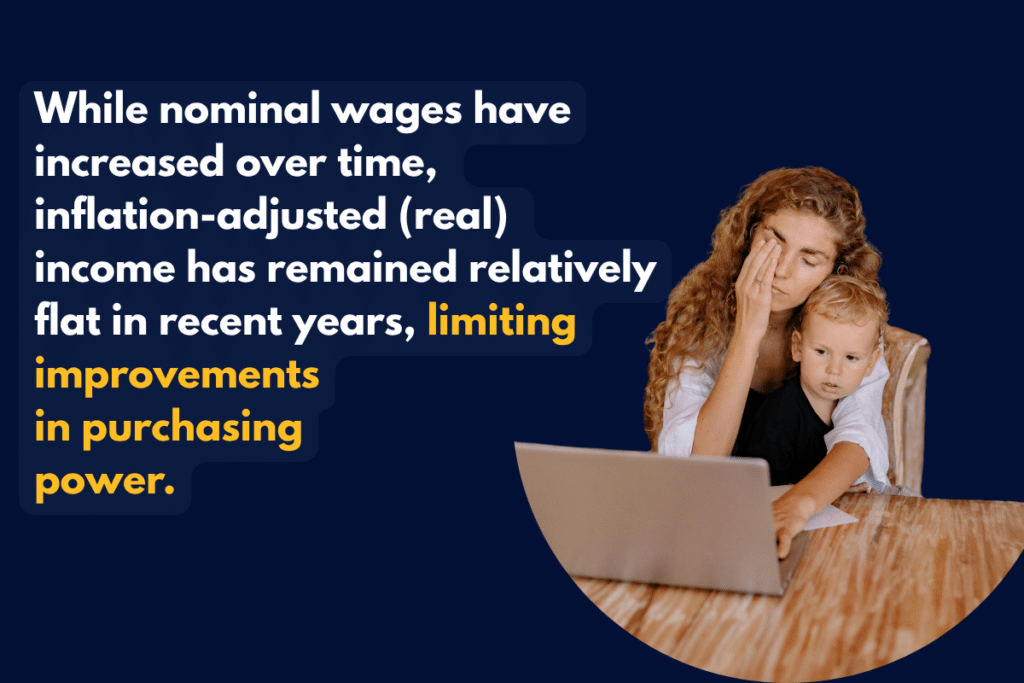
According to U.S. Census data, median household income has seen minimal real growth when adjusted for inflation, particularly following the spike in prices after 2020.¹
At the same time, the cost of essential goods and services, including housing, food, and transportation, has increased, reducing the amount of disposable income available to households.
Inflation and Reduced Purchasing Power
Inflation has played a central role in shaping financial conditions. Between 2021 and 2023, the United States experienced the fastest inflation growth in over four decades.
Data from the U.S. Bureau of Labor Statistics (BLS) shows that consumer prices rose significantly across major spending categories, including groceries, energy, and housing.²
Although inflation has moderated, price levels remain elevated. As a result, households continue to experience reduced purchasing power compared to pre-2020 levels.
Record Levels of Consumer Debt
Rising expenses combined with limited income growth have led many consumers to rely on credit. According to the Federal Reserve Bank of New York, total U.S. credit card debt reached approximately $1.28 trillion in 2025, the highest level on record.³
In addition, average credit card interest rates have exceeded 20%, increasing the cost of carrying balances and making repayment more difficult for borrowers.⁴
These conditions contribute to a cycle in which households rely on credit to meet expenses while facing increasing interest costs.
Housing Affordability Challenges
Housing remains one of the largest financial burdens for American households. Both home prices and rental costs have increased significantly over the past decade.

Additionally, rising mortgage rates and home prices have made homeownership less accessible, particularly for first-time buyers.
Limited Emergency Savings
Many households lack sufficient savings to absorb financial shocks. According to the Federal Reserve’s Survey of Household Economics and Decisionmaking, a significant portion of Americans would have difficulty covering an unexpected expense without borrowing or selling assets.⁶
Limited emergency savings increase financial vulnerability and often lead to greater reliance on credit during emergencies.
Rising Healthcare and Education Costs
Healthcare and education expenses continue to place additional strain on household budgets.
Employer-sponsored family health insurance premiums have risen steadily, reaching nearly $27,000 annually in recent data from the Kaiser Family Foundation.⁷
At the same time, student loan debt remains a major financial obligation. The Federal Reserve estimates that approximately 45 million Americans hold student loan debt, totaling around $1.6 trillion.⁸
These expenses represent long-term financial commitments that can limit savings and wealth-building opportunities.
Increasing Food Insecurity
Food affordability has become a growing concern. According to the U.S. Department of Agriculture (USDA), millions of households experience food insecurity each year, meaning they lack consistent access to enough food for an active, healthy life.⁹
Rising food prices have contributed to this issue, particularly for lower- and middle-income households.
Conclusion: Understanding the Financial Pressure
The perception that Americans are becoming poorer is supported by several measurable economic factors, including stagnant real wages, sustained inflation, rising debt levels, and increasing costs for essential needs such as housing, healthcare, and food.
While the overall economy remains strong by global standards, these underlying pressures continue to affect individual financial stability.
Understanding these trends can help individuals make more informed financial decisions and better navigate economic uncertainty.
Check out the CreditNinja dojo for topics like Why the Cost of Living Is Rising, and How to Manage It Now, 5 Major Money Milestones to Hit in Your 30s, and more!
References
- U.S. Census Bureau | Income and Poverty in the United States
- U.S. Bureau of Labor Statistics | Consumer Price Index (CPI)
- Federal Reserve Bank of New York | Household Debt and Credit Report
- Federal Reserve | Credit Card Interest Rates Data
- U.S. Census Bureau | Housing Affordability Data
- Federal Reserve | Survey of Household Economics and Decisionmaking (SHED)
- Kaiser Family Foundation | Employer Health Benefits Survey
- Federal Reserve | Consumer Credit / Student Loan Data
- U.S. Department of Agriculture | Food Security Report
- A new CNN poll sum up Americans’ feelings about the economy: They just feel stuck | CNN Politics